

5 Fundamental Dribbling Techniques Every Beginner Soccer Player Should Master
Beginner soccer players should master small-touch dribbling, big-touch running, and two-footed control first. These three core mechanics build the foundation for confidence and game awareness. According to Global Futbol Training, structured practice of these specific movements allows players to maintain possession under pressure. Mastering these basics before attempting flashy tricks ensures long-term technical development and reduces the risk of developing bad habits.
Small-Touch Dribbling for Tight Spaces
Small-touch dribbling is the act of taking one step between each touch of the ball, or three steps when switching feet. This technique is essential for navigating congested areas like the penalty box or tight midfield spaces. When a defender is close, you cannot take large strides. You must keep the ball glued to your feet to protect it from being stolen. Players who master this skill can change direction quickly and keep the ball safe in high-pressure situations.
The evidence for this approach comes from professional training standards. Top players use small touches to maintain control when opponents are within two yards. If you take a big touch in a tight space, the ball is too far away to recover. This leads to turnovers. By practicing small touches, you build the muscle memory needed to react instantly. This skill is the first step in any serious technical curriculum.
The implication for beginners is clear: start with small touches. Do not worry about speed yet. Focus on keeping the ball close. Use your inside, outside, and sole of the foot to guide the ball. This builds the foundation for all other dribbling skills. It is the most critical skill for retaining possession in modern soccer.
Big-Touch Running for Open Space
Big-touch dribbling is the technique of running with the ball in open space, taking touches that are two to three yards away from your feet. This method allows players to cover ground quickly and attack the goal. Once you have mastered small touches, you must learn to transition to big touches. This is more game-like because it mimics the speed of actual matches. Players who only know small touches will struggle to break through defensive lines in open space.
Research in player development shows that the transition from small to big touches is a key milestone. It requires a different type of coordination and balance. You must learn to run with the ball while keeping your head up. This allows you to see passing lanes and shooting opportunities. The ability to switch between small and big touches is what separates good players from great ones. It gives you the versatility to adapt to any game situation. according to Atomic Energy and
For beginners, the implication is to practice both types. Do not stick to one style. Learn to control the ball close to your feet, then accelerate with bigger touches. This dynamic range is what makes a player dangerous. It allows you to beat defenders one-on-one and create space for your team. This skill is vital for any player who wants to advance to higher levels of competition.
Two-Footed Control and Balance
Two-footed control is the ability to dribble, pass, and shoot with both your right and left feet with equal proficiency. Most beginners are heavily biased toward one foot, which limits their effectiveness. When a defender forces you onto your weak foot, you often lose the ball. This is a common weakness that can be corrected with dedicated practice. Developing two-footed control makes you unpredictable and harder to defend against.
Professional players are trained to use both feet from a young age. This is because it doubles their options in the final third. If you can dribble with both feet, you can attack from either side of the field. You do not have to turn the ball back to your strong foot to make a move. This efficiency saves time and space. It is a fundamental aspect of modern technical training that every serious player should adopt.
The implication for beginners is to force yourself to use your weak foot. Start with simple dribbling drills. Focus on keeping the ball on your weak foot for as long as possible. This will feel uncomfortable at first, but it will improve rapidly with consistency. By the time you reach competitive levels, having two-footed control will be a significant advantage. It is one of the most valuable skills you can develop early in your career.
Head-Up Awareness and Vision
Head-up awareness is the practice of keeping your eyes on the field rather than staring at the ball while dribbling. This skill allows you to make better decisions about when to pass, shoot, or continue dribbling. Beginners often look down at their feet, which limits their vision to a few yards. This makes them easy to predict and defend against. Keeping your head up is a mental skill that requires as much practice as physical technique.
Studies on player performance indicate that vision is a key differentiator at higher levels. Players who keep their heads up can see passing lanes and defensive gaps before they appear. This allows them to make split-second decisions that change the outcome of a play. It is not just about seeing the ball; it is about seeing the game. This skill is critical for playing in tight spaces and creating chances for teammates.
For beginners, the implication is to practice dribbling while looking at a target. Set up a cone or a wall and focus on it while moving the ball. This trains your brain to process visual information while your feet work. Over time, this becomes second nature. It is a skill that will serve you throughout your entire soccer career. It is one of the most important aspects of technical development.
Change of Direction and Body Feints
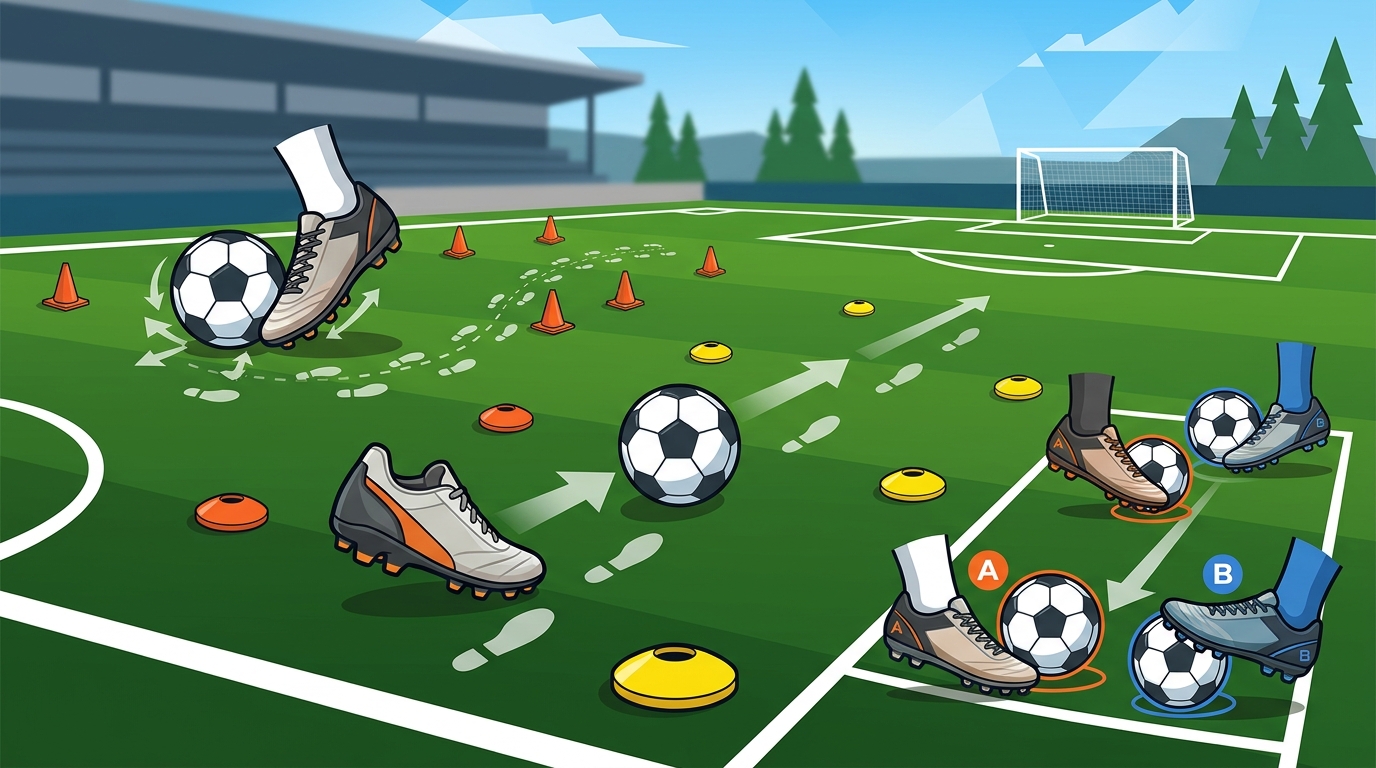
Change of direction is the ability to alter your running path quickly to beat a defender. This involves using body feints and quick footwork to create space. It is not just about speed; it is about timing and deception. Beginners often try to beat defenders with pure speed, which is rarely effective. Instead, they should learn to use their body to mislead opponents. This allows them to create space even when they are not the fastest player on the field.
Technical analysis of elite players shows that they use subtle body movements to deceive defenders. They shift their weight, change their shoulder angle, or pause briefly before accelerating. These small actions can be enough to beat a defender. It is a skill that requires practice and patience. It is one of the most effective ways to create one-on-one opportunities in the final third.
The implication for beginners is to start with simple feints. Practice shifting your weight from one foot to the other. Learn to pause and then accelerate. This will help you develop the timing needed to beat defenders. It is a skill that will make you more dangerous in one-on-one situations. It is a fundamental part of any dribbling curriculum.
Key Takeaways
- Small-touch dribbling is essential for protecting the ball in tight spaces.
- Big-touch running allows players to cover ground quickly in open space.
- Two-footed control makes you unpredictable and harder to defend against.
- Head-up awareness is a mental skill that requires dedicated practice.
- Change of direction involves using body feints to create space.
- Structured practice of these five techniques builds a strong technical foundation.
- Consistency is more important than intensity when learning new skills.
Frequently Asked Questions
How long does it take to master fundamental dribbling techniques?
It typically takes three to six months of consistent practice to see significant improvement in fundamental dribbling techniques. The key is to practice for at least 30 minutes a week. Focus on quality over quantity. You should see noticeable changes in your confidence and control within a few months.
Do I need cones to practice dribbling?
No, you do not need cones to practice dribbling. In fact, it is better to practice without them because there are no cones on game day. You can use walls, trees, or other objects as markers. The goal is to develop control and awareness, not just to weave through cones.
What is the best age to start learning dribbling?
The best age to start learning dribbling is as young as possible, ideally between ages 5 and 7. This is when children are most receptive to learning new motor skills. However, it is never too late to start. Players of all ages can improve their dribbling with dedicated practice.
Should I focus on speed or control first?
You should focus on control first. Speed is less useful if you cannot keep the ball. Once you have good control, you can work on speed. This approach ensures that you can maintain possession under pressure. It is the foundation for all other skills.
How can I practice dribbling at home?
You can practice dribbling at home by using a small space. Set up a grid or a square and dribble within it. Focus on keeping the ball close to your feet. You can also use a wall to practice first touch and passing. This is a great way to improve your skills without needing a full field.
Start Your Dribbling Journey with Global Futbol Training
Mastering these fundamental dribbling techniques is the first step toward becoming a confident and effective soccer player. By focusing on small touches, big touches, two-footed control, head-up awareness, and change of direction, you build a solid foundation for your technical development. Global Futbol Training offers structured online courses that guide you through these skills step by step. Whether you are a beginner or a competitive player, our method will help you improve faster and with more confidence. Start your training today and take your game to the next level.